

Are we "Canada down" enough to save Canadian media?
Or is it too late?
I’ve sat on this post for a few months now, because while the decline of Canadian media and televisions is close to my heart, it’s the kind of inside baseball talk that tends not to be of much interest to outsiders, even within Canada’s borders.
Then the “Y’all know I’m Canada down” trend started, invigorating Canadians and aficionados across social media to reminisce and indulge in Canadian nostalgia. A lot of it centered around Canadian content, entertainment properties, kids shows, television networks… many of which don’t exist anymore.

It’s easy to blame “American dominance” for the decline in Canadian media, but the hands on reality is more boring and dry; regulatory failures1 and favouritism towards conglomerates interested in eliminating competition.
Canada has long been known for the regulatory framework that ostensibly exists to support Canadian media and serve public interest. You might have heard about the Canadian Content (CanCon) rules that require radio and television channels to broadcast a certain percentage of Canadian produced/originated content in order to be in compliance and maintain their broadcast license and funding.2 This also applies to investing and developing content.
Despite this regulatory framework, the local industry struggles and has essentially collapsed into vertically integrated conglomerates, that both create content and control its distribution and availability.
This has been particularly notable in the kids space, and is personal to me because I worked in Canadian television for over a decade, until last year, when the legacy children’s and family channel I worked for shuttered. This didn’t happen because of American dominance in the media industry, nor did it happen because we were losing subscribers. It happened because the Canadian Radio-television and Telecommunications Commission (CRTC) failed to uphold their stated purpose of promoting competition, serving public interest and supporting the industry.
The channels I worked for were not the first victims, but one that I watched growing up was. Vrak TV, a French language channel, which I saw some people reminiscing over on Twitter as part of the “Canada down” trend was shut down in 2022. Not because it was no longer profitable or subscribers were dwindling, but because the channel’s Quebecois carrier, Videotron, decided to cease distribution of the channel. By default this would strip the channel of all its subscribers, because they would no longer have access to it.
Bell Media, owners and operators of Vrak lodged a complaint with the CRTC, claiming, “Videotron was conferring an undue disadvantage on Bell Media, while giving itself undue preference by continuing to distribute its own French-language discretionary services.”
The claim was essentially that Quebecor, the conglomerate that owns Videotron, was cutting out the competition from their distribution services while they continued to cater to the same demographic with their own programming. The CRTC ruled against Bell Media in this case, determining that since both parties are vertically integrated BDUs there was “no imbalance,” which is funny, because Videotron essentially has a monopoly in Quebec, the only market that matters for French language services. Yet Bell Media having a large footprint in the English market was used against them.
Ultimately, this decision set the stage for Bell Media and Rogers, the broadcasters with a stranglehold on the English market, to decide to cease distribution of the suite of Family branded channels. WildBrain, the company that owned Family Channel, Family Jr, WildBrain TV and Télémagino, appealed the decision and spent years in arbitration.
Ultimately, the CRTC ruled that it was fine for two companies with market dominance, and their own competing services, to drop an independent suite of channels. This time, there could be no claim that WildBrain was also a vertically integrated company that was on equal footing as these two conglomerates. I am biased, as someone who worked at Family Channel for many years, but it just reeks of anti-competitive practices. Because there was no possibility to keep the channels running when losing access to an overwhelming majority of their subscribers. Especially not when pivoting towards streaming and establishing a footprint outside of the traditional linear distribution model was considered antagonistic towards those carriers.
Beyond removing competition, the closure of the channels also ensured a much poorer environment for media and entertainment producers. Because of the Cancon rules and the Canadian Media Fund’s broadcaster envelope program, every year, the channels commissioned and invested in the Canadian media ecosystem. Supporting creators and getting series and films made was part of the deal.
Just like many viewers worldwide assumed that Heated Rivalry was an HBO production because that was the show’s international distributor, many of the WildBrain commissioned productions ended up on Netflix or other streamers, being assumed to be their originals when they were actually either fully funded or co-funded by a Canadian company. Shutting down four channels that were out there, commissioning and acquiring international content has meant making the cultural landscape all the more arid. As Ed Sum put it,
“Canadian shows face extra trouble. Homegrown cartoons could get buried online somewhere on CBC’s archives instead of being on TV. A Family Channel premiere used to be a big deal; now it might get lost in an endless list on a streaming service.”
Because the disintegration of funding and outlets for kids and family content does impact adult content. The Canadian media landscape continues to limp along, with a few outliers making noise. I’ve seen people say that hopefully the success of Heated Rivalry means Canadian media will gain more respect, but the problem isn’t with international recognition. And the massive success of a low-budget series isn’t going to increase funding for others—it’s not even getting more funding for its second season!—it’s simply going to keep lining the pockets of those in power. Even successful Canadian actors have called out the broken system, as Heated Rivalry’s own François Arnaud said in 2023,
“There is something that is even more upsetting, I find, in Quebec, because in the United States, in Hollywood, they at least have the excuse of being ruthless capitalists. Whereas here, it’s state money, it’s taxpayers’ money. And we are taxpayers ourselves, and contributors. It’s an investment by the state in its culture. And then the fact that the profits are distributed, and you see the producers shamelessly posing in their castles with taxpayers’ money, I find that quite revolting.”
[translated from French]
Arnaud was referring to the Quebec media landscape specifically, where there was a looming strike at the same time as SAG-AFTRA was striking in the US. Because greed finds a way, and regulatory bodies can lose their purpose and work against their stated intentions.
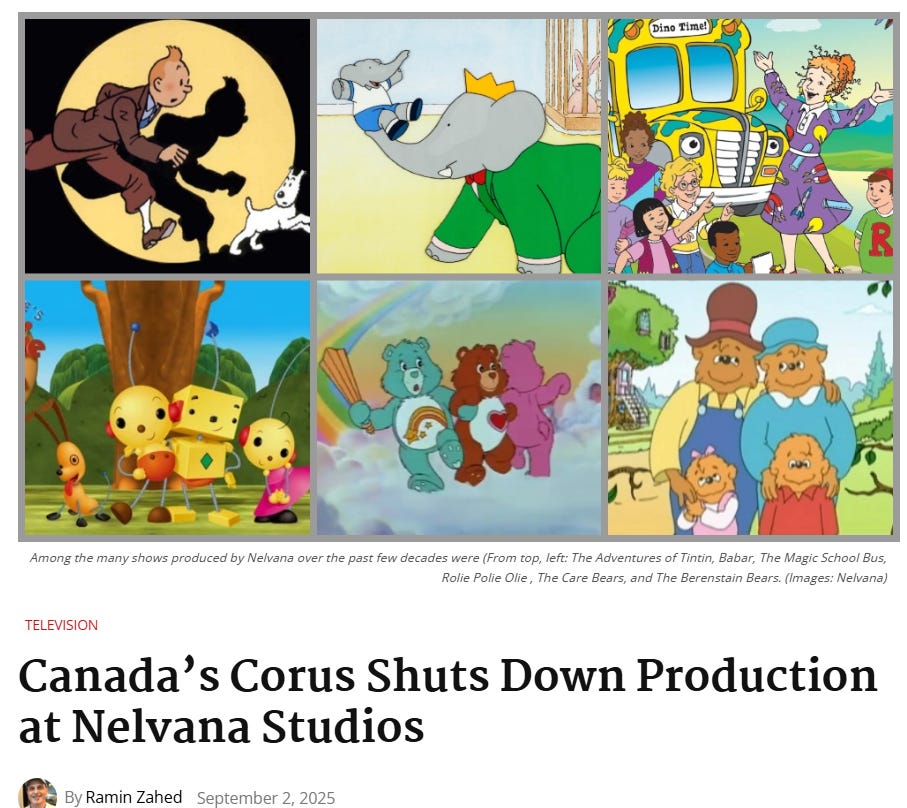
It wasn’t long after the shutdown of the Family suite of channels that Corus, the only remaining independent broadcaster and commissioner of children’s content, announced that their historic animation studio Nelvana would cease production. They also chose to shutter five of their children’s channels. Perhaps because the CRTC ruling against WildBrain taught them that it would be a waste of effort to fight for continued carriage, especially if it would impact their continuing relations and carriage of their general interest channels.
The problem isn’t that these companies are conducting business as usual, but that the system that is meant to support the infrastructure and keep it competitive utterly failed. The result isn’t just that a handful of channels no longer exist, but that there are cutdowns on production and development, commissioning as well. Leaving Canadian creators to fight for far fewer opportunities, and fewer chances to develop. The scene is being bled dry. The irony is that the resulting American dominance that is blamed for the decline of Cancon is really the end result of regulatory failure, not the cause.
The biggest being the failure to hold streaming services to the same standards as broadcasters, something that the Online Streaming Act is supposed to address, but it’s too little, too late.
Even Heated Rivalry’s Jacob Tierney has said that the show is going to remain very Canadian in the future in order to retain the funding it has received.
This is true in every Canadian endeavour: the government makes rules and then doesn't enforce them or creates a system that is simply dumb. It supports creation but not consumption. And what has happened is a populace that doesn't care, frankly. English Canada does not care about "culture." Atwood called Canada a land of "cultural morons" and she wasn't wrong.