

'Twilight' Widowers, 'Heated Rivalry' Divorcees and The Safety of Wanting What You Can Never Have
Dispatch from a longtime slash fan.
Welcome to Fandom Exile, your destination for anti-nostalgia fandom research and cultural criticism.
While I was scrolling on Twitter, I came across a video from Instagram that was being mocked and shared widely. It was a woman who said she was getting a divorce because the show Heated Rivalry made her realize she “deserves better” and she was surprised to discover she was one of many fans experiencing a wake call because of the show. Of course the Twitter spin (and a lot of comments on her post) were along the lines of this tweet saying “imagine destroying your marriage because you're obsessed with fetishising gay men and gay porn”
First of all, it’s not new at all for hyperfixations to disrupt relationships and in some occasions, cause divorces. Twilight was a big enough scapegoat for this that Time Magazine reported on it, it was discussed on Twilight boards among the fans themselves, and “Twilight Widowers” were also vocal in their own spaces, complaining that their partners were suddenly expecting a different dynamic and refusing to settle for what they used to. The same could be said for an endless amount of fandoms and hyperfixations because what happens is it activates a desire for a larger than life experience and romance. The emotional high that comes from consuming and inhabiting these worlds can’t compete with reality. And in some cases, it may be a warranted wake up call. In others, it’s possible the women will realize they done fucked up years later.
Just reading about the way Margaret Qualley and Jack Antonoff’s apparent separation is being framed by many (lots of “good for her!”) is reminding me of this. Natalie Reilly’s post on the matter is very good, at least for someone uninitiated like myself. The projection, based on what we’ve been told and observed of the two is that he’s kind of a schmuck (an incredibly talented and rich one) but that he represents the guy who fails to live up to expectations.
If Qualley came out and said it was watching Heated Rivalry that made her realize she deserved more, would the same people cheering her on roll their eyes and scoff? Or is it just okay to fantasize about Lena Dunham’s book being the wake up call?
But I digress.
What binds Twilight and Heated Rivalry (or other gay romance content) is the erotical illusion that it presents us with. Ogi Ogas and Sai Gaddam coined the term and explore it in their book, A Billion Wicked Thoughts.

The way Ogas and Gaddam explain it, erotical illusions are sexual cues “spliced together in novel combinations that can dupe or hyperstimulate our sexual perception.” This by default includes things like vampires and the fandom-created Omegaverse, but this is also the underlying mechanism behind romance tropes like enemies to lovers, secret relationships, friends to lovers, forced proximity, etc. These tropes can often be referred to as “kinks” in fandom spaces, even though they are not actually kinky. What that means is simply that those tropes hit a specific spot for the reader, and it doesn’t have to be explicit or smutty to deliver satisfaction. And in the world of gay romance, it also includes the way that men and gay relationships are portrayed.
Rachel Reid, the author of the Game Changer series that Heated Rivalry is part of, said, “I don’t think it’s at all surprising that women would wanna see men being emotionally vulnerable, watch them yearn and struggle and hurt and grow, be kind and patient and loving.” One of the stars of the show, François Arnaud, has also spoken up about how while the series is about gay relationships, part of the appeal is seeing hypermasculine men reckon with vulnerability. And the way many of the fans who gained interest in real life hockey and found themselves devastated that the real players couldn’t compete with their fictional counterparts supports this.
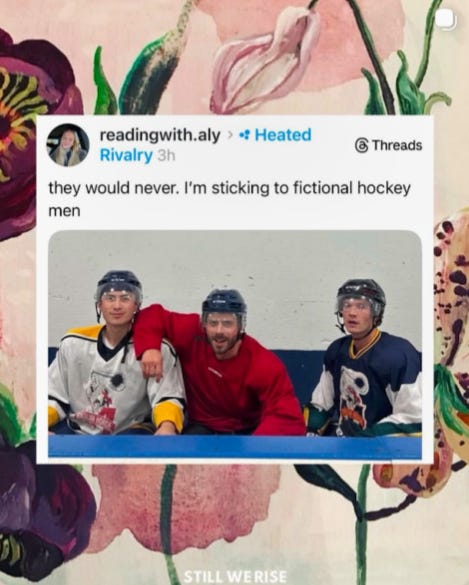
The smut may have drawn people in, but it only works because the interpersonal dynamics also deliver. And these dynamics are fantasy and not something you’d encounter in the real world. While Reid and many of the female writers of gay romance are attracted to men, there are also slews of lesbians that are in this space and use male characters to portray lesbian dynamics. I understand that queerness and lesbianism has been questioned and challenged more than usual over the past decade because of the rise of things like lesbians who have sex with men, but the prevalence of lesbians in the fandom community around gay men predates this discourse.
The dynamics that are perceived in this fiction are simply not realistic, not just for gay relationships but straight relationships, and dare I say, even when it’s lesbian dynamics being injected, not all lesbian relationships are romantic fairytales either. Toxicity still exists in those communities. This is fiction. It’s idealized fiction, at that. In a way, unlike lesbian readers and writers, I feel like you can almost tell what which women are attracted to men prefer because they focus tremendously on penetrative sex as the be all and end all of consummation.
Now, does it matter that we’re talking about two guys? Of course. The slash, the yaoi, the M/M or MLM, the fujoshi of it all is what draws some women in. Are there women who fetishize gay men? Yes, absolutely. But that’s not all of them, and the psychology behind it is actually way more complex. It’s probably a hot take but I genuinely think there is a substantial difference between men who fetishize lesbians and the women who consume gay stories. Where are the men writing fanfiction for lesbian characters? Are they watching The L Word and swooning over the relational dynamics and drama? Are they consuming Alexandra Swarens’ oeuvre religiously? Doing lists of the best sapphic film and television shows? Not really. Lesbian stories rarely escape their niche because they don’t tend to attract male audiences the way gay stories attract women.
A fundamental difference in approach is that men want to be inserted into the lesbian scenario, whereas women want to observe it from afar, or they self-insert as one of the men. The fantasy I’ve heard from men is that they’ll find lesbians in flagrante and be embraced because they’ve ultimately been missing dick, and that the man arriving on the scene is actually getting them more excited. The fantasy from women is typically not about being included in the first place. And of course, there’s the self-insertion that frequently happens, but what is notable and rarely discussed is how frequently this self-insertion isn’t about seeing yourself as the receptive partner. In fact, it can be about being the one actively debauching their favourite character, consuming him and making him fall apart.
In the case of Heated Rivalry, something that goes against the fetishization narrative is that they should, in theory, embrace the secondary couple in the show and want the other couples in the series to be represented, but many of them don’t. They think the story about the closeted athlete who meets an out barista is boring and “heteronormative” because there’s less of a rollercoaster of emotions, it’s a straightforward romance where the reality of being closeted is the largest obstacle. They don’t want Shane and Ilya to “lose” screentime to a couple and a trope that they don’t care for and doesn’t give them the same emotional high.
What I think is more accurate to say is that specific dynamics are fetishized, and the couple (ship) that is chosen represents those dynamics in a way that pleases them. This is why there is such a thing as migratory slash fandom: these fans are into gay romances, but only a specific type of gay romance. Those for whom Shane and Ilya’s love story is the superior one are not interested in any other ships and dynamics. They like the dominant fuckboy who changes his ways for the uptight phenom who warms up under his attentions. Each romance novel in a series tends to follow a specific trope because the tropes have fans. This is the same situation.
This is also why I’m loath to say the popularity of these shows suggests that the audience is progressive. How can it be progressive to campaign against more representation, against the telling of different love stories? For many, these tropes are scratching a very specific itch and providing a very real emotional high. But that doesn’t make it a political act.

What about the women who are attracted to gay men?
Now, I also want to talk about the women who are attracted to gay men. Not to therapyspeak too much, but this is essentially an attachment issue. Desiring men who cannot and will not desire you, ever, is the safest thing you can do. It’s your nervous system protecting itself from being hurt. Some women will go for married men or those who are emotionally unavailable, which brings more chaos into their lives. But a gay man who cannot ever reciprocate? This allows you to simply live out a fantasy that will never be fulfilled.
Ron Cowen and Daniel Lipman, the creators and showrunners of the American edition of Queer as Folk from 2000, discussed their surprise that women made up such a large part of their audience. They emphasized that it was straight women, but I knew plenty of lesbians who were in the fandom, too. They discussed receiving fanmail from women that said, “I pretend in my fantasy that I’m a gay man having sex with Brian.” These women were not fantasizing about “turning” Brian but of being someone he would already desire. (Again, a difference between the standard male fantasy of lesbians and women’s fantasy of gay men.)
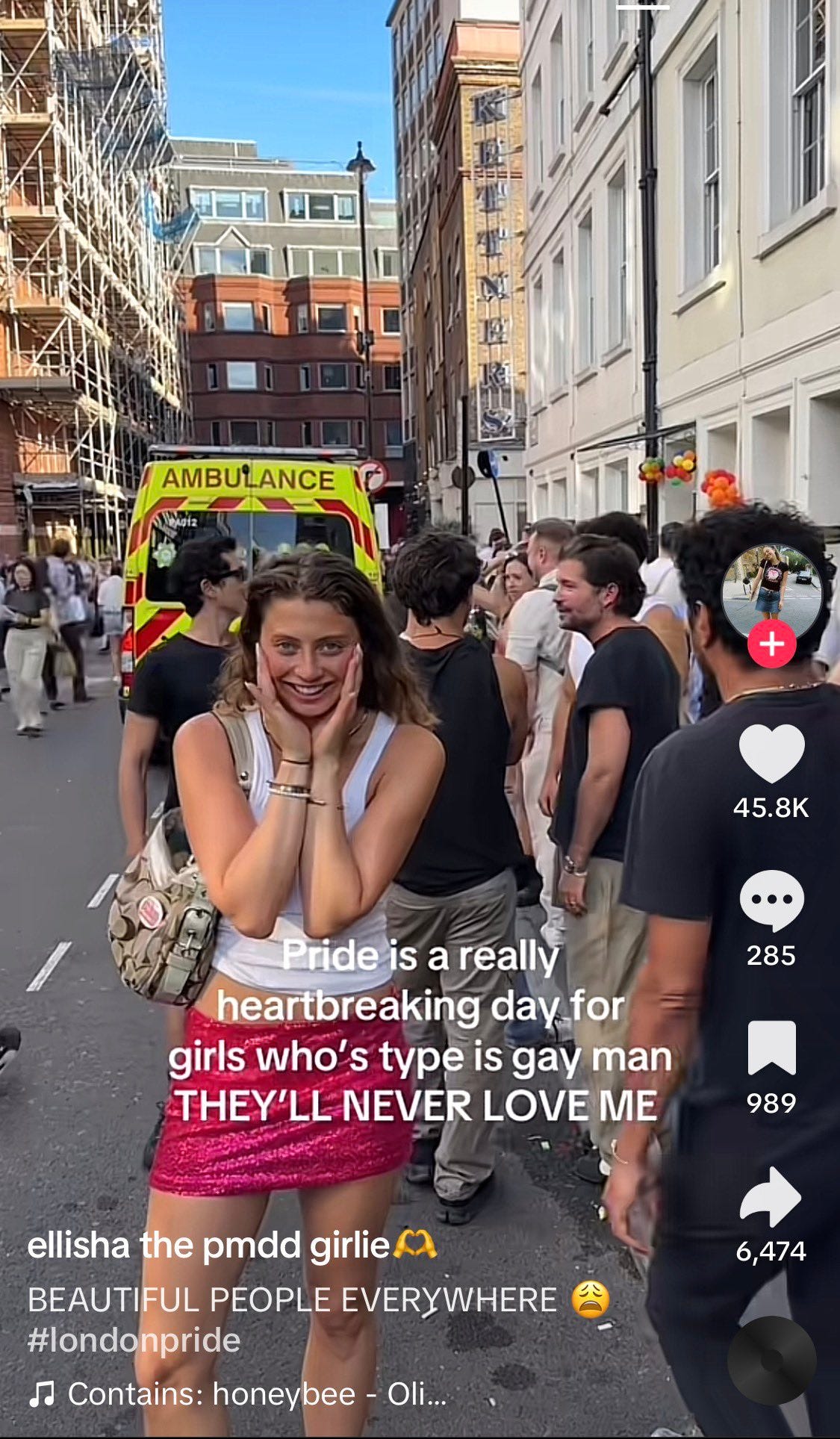
This is also why I’m partial to the theory that a lot of women drawn to slash and gay romance like that there are no women there. It’s something that faces a lot of criticism from feminists because stories without women are not a positive for women and this is true! But I’m not saying this is good, I am simply saying that it is a preference that exists.
It is incredibly safe to desire gay men. You avoid vulnerability and a mutual relationship where you have to meet each other halfway, where you have to come to terms with the reality of intimacy with another person. You’re on the outside, observing. And perhaps this is partly related to the proliferation of so-called aegosexuality.
I’ve discussed it briefly before, but to summarize, aegosexuality describes “a disconnection between oneself and a sexual target/object of arousal.” Aegosexuals are considered part of the asexual spectrum because they do not want to actually engage in the fantasies they have. They are not present for them. Their sexual highs and kinks depend on them being absent from the scenarios. They don’t want to participate, remaining detached and outside any given fantasy. Doesn’t that sound like a lot of the women that are into these gay romances?
If desiring gay men is a safe target, then desiring to be absent from your sexual fantasy is even safer. You don’t have to lament the lack of reciprocity because it’s not even part of your fantasy. It’s an abdication of being the main character in favour of being an observer.
This is not a clinical diagnosis, of course, but it’s something I’ve noticed in my 20 years of being in slash fandom and interacting with other women in this space.
I also wonder how much of this is a result of the average sex act being unfulfilling for many women. In plenty of cases, this could be solved by working with your partner, but that’s not how romance works.
The sex that is depicted in romance books and fanfiction is by default fantastical, earth shattering, orgasmic every time. A first kiss comes with fireworks. The depiction of sex in romance genres gives readers unrealistic expectations—this applies to gay and straight romances. The data about women who orgasm from penetrative sex alone is disputed, but the reality is there are a lot of women who don’t. And those who don’t may very well be drawn to the stories where sex is immediately fulfilling, because why wouldn’t you? Fanfiction and romance stories rarely deal with the difficulty of working out sexual dynamics. The more you read, the more you might expect the ease of sexual satisfaction for something that is easily achievable in real life. (See also the swaths of women annoyed at Cosmopolitan guides that ultimately didn’t work for them, because why wouldn’t they?) This becomes problematic when these fantasies are internalized as something that should be achievable.
Romance novels and stories in general portray soulmate shit that is simply not reflective of life for most of us. It’s the same situation as wanting to fix the bad boy, loving toxic relationships on screen because of the emotional rollercoaster all the while having a boring (complimentary) relationship in the real world.
I’m reminded as well of all the European romanticism that has been flooding my personal Substack feed, with occasional rebuttals (that underperform, comparatively) from actual Europeans. Because the dream is so vivid, we can picture ourselves in Italy, not caring about what we look like, in France having croissants and strolls on cobblestone streets. But wherever you go, there you are. And in relationships, that means your relationship issues.

It isn’t realistic to expect a fairytale romance. A soulmate, someone who will fight for you that you actually desire equally will not magically fall out of the sky. But that doesn’t stop women from wanting it. And maybe some women prefer to be alone if they can’t have that. The vicarious romance can be fulfilling in its own way, and this is undoubtedly a result of our tech landscape which has hijacked our imaginations and fantasies.
We can mock it all we want, but it won’t change that it’s a real phenomenon, and dismissing all women in these situations as fetishists ruining their lives over fantasies doesn’t do anything but alienate them and those who find themselves in these spaces.
But this isn’t to say that all of us who engage with these stories are doomed. I know plenty of women who were inspired to pick up dating again because of the show, because love and romance suddenly felt worth the effort. Plenty of women who are in happy, stable relationships who were obsessed with the show and it didn’t disrupt their relationship more than any other hyperfixation.
I actually disagree with it being different for men. I think the aegosexuality dynamic is identical to what men get from porn. No dealing with emotional intimacy, which is difficult and messy, no dealing with your own physical inadequacy or anxieties about performing sexually. These things are "safe" in a certain sense. "Cuckold" porn is the most extreme version, literally getting off on not participating at all.
I guess what I'm trying to say is that while the fantasies might be different, the underlying mechanism isn't...at all.
I had a friend whose wife was a Twilight wife. Like she had the same Jeep that was in the movie. They took at least one vacation to the PNW where it was filmed. I have no idea if it factored into their divorce but it wouldn’t surprise me.